Liangliang Sun honored with Red Cedar Distinguished Professorship
Liangliang Sun, a professor in the Department of Chemistry, has been honored with a 2026 Red Cedar Distinguished Professorship.
The title, supported by MSU’s Office of Research and Innovation and the Office of the Provost, recognizes Sun’s pioneering work at the crossroads of analytical chemistry and biology.
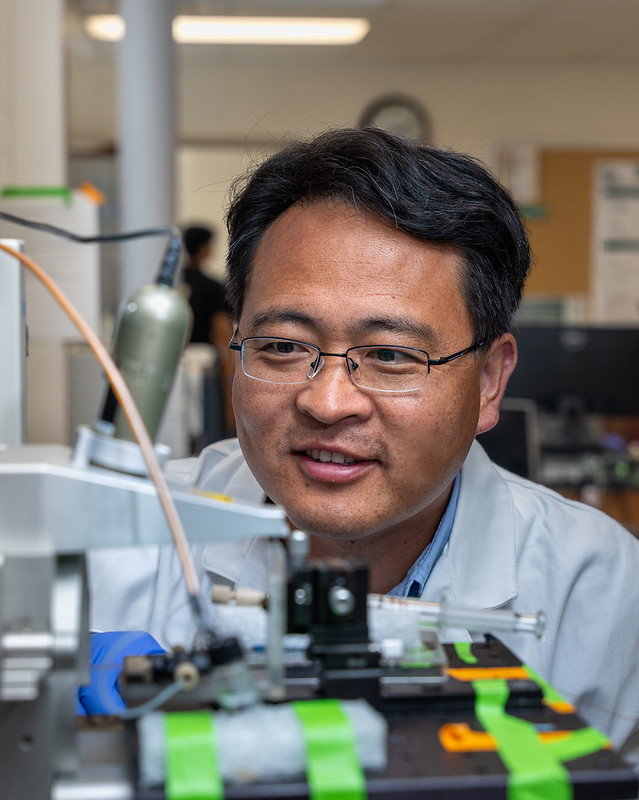
By reshaping mass spectrometry-based protein research used in biomedical science, his team is revolutionizing our understanding of the molecular mechanisms behind diseases such as cancer and Alzheimer's.
“Dr. Sun's work exemplifies the boundary-crossing science that defines our college and university,” said Eric L. Hegg, dean of the College of Natural Science.
“By pushing the limits of what mass spectrometry can reveal about the proteome, he's giving researchers around the world new tools to understand disease at its molecular roots.”
At MSU, Sun’s lab specializes in what’s known as top-down proteomics.
Rather than breaking proteins into smaller fragments for study, this approach looks at the big picture – how intact proteins derived from the same gene, also known as or proteoforms, can take on a kaleidoscopic array of shapes, each with different functions.
Using biological systems like human colorectal cancer cells, human brain plasma and zebrafish embryos, Sun studies how proteoforms guide the initiation and progression of diseases during the earliest hours of vertebrate development.
These early glimpses are leading to the discovery of critical proteoforms found in colorectal cancer, Alzheimer's disease and certain birth defects – findings crucial to improving diagnosis and therapeutic development.
The Sun Lab is likewise aiming to develop a "proteoform atlas” of a human cancer cell line.
This effort will provide a bird’s-eye view of proteoforms expressed in cancer cells, helping establish a foundation for further studies of how proteoforms modulate cancer development.
“When we study biology, we must study proteoforms,” said Sun, who noted that current estimates place around a million different varieties in the human body.
“One big challenge of studying proteoforms is the extremely high complexity. One gene can produce tens to hundreds of proteoforms with a high concentration dynamic range.”
To advance top-down proteomics, Sun leverages a simple and powerful analytical method called capillary electrophoresis-mass spectrometry, or CE-MS.
By continually pushing this technology into new territory, Sun is helping researchers study proteoforms with sensitivity, scale, and depth that conventional tools simply can’t reach.
“Measuring the types of proteoforms expressed in cells, tissues and biofluids and the dynamics of proteoforms across biological conditions on a proteome scale with high throughput and high sensitivity will transform biomedical research,” said Sun.
“This requires the technological breakthroughs of mass spectrometry-based top-down proteomics.”
Sun joined MSU’s Department of Chemistry in 2016, and since then, has received numerous accolades and national support recognizing the far-ranging promise of his team’s science.
These include a National Science Foundation Early CAREER award, a $2.2 million National Institutes of Health MIRA grant, two National Institutes of Health R01 grants totaling $3.6 million, multiple industry grants, and the inaugural Thermo Fisher Scientific Early Career Award by the International Symposium on Microscale Separations and Bioanalysis.
Established in 2022, the title of Red Cedar Distinguished Professor is given to faculty who not only exhibit stellar scholarly accomplishment, but also demonstrate a dedication to mentorship – a calling all too familiar to Sun.
He’s the recent recipient of the College of Natural Science’s Graduate Academic Advisor Award, and across his many projects you’ll find a commitment to scientific outreach and education.
The Sun Lab regularly organizes opportunities for students of all levels to get hands-on research experience in proteomics and mass spectrometry, as well as a highly successful, MSU-hosted summer school dedicated to CE-MS.
“Training the next generation of scientists for cross-disciplinary research is challenging,” said Sun.
“An advisor needs to spend time with students to make sure they establish a solid
foundation of scientific knowledge and skills, and needs to be patient with their
growth into independent scientists.”