Actinide Chemistry
The bonding interactions between f-block elements and ligands have become a topic of interesting debate. In contrast to d-block systems, where bonding involving d-, s- and to a lesser extent p-orbitals is relatively well understood, bonding in the actinides is believed to involve varying degrees of f- and d-orbital participation depending on orbital extension and energy in the complexes. This variance in orbital participation is complicated further due to varying degrees of ionicity in the bonds as well. Through the use of a new method of ligand parameterization specifically designed for high valent systems we aim to elucidate some of the intricacies involved in actinide-light element reactivity.
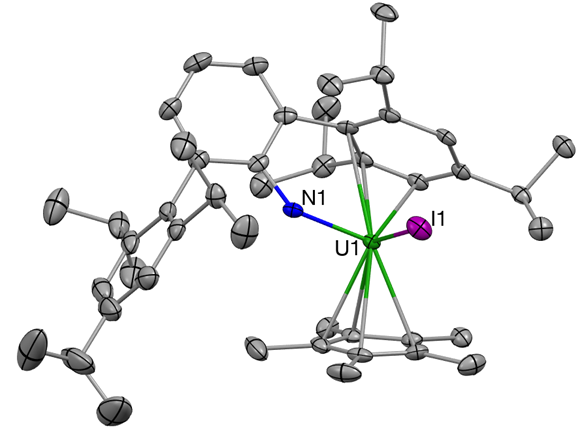
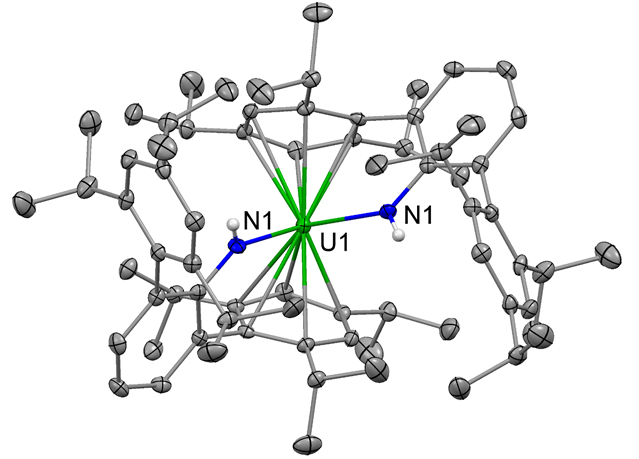
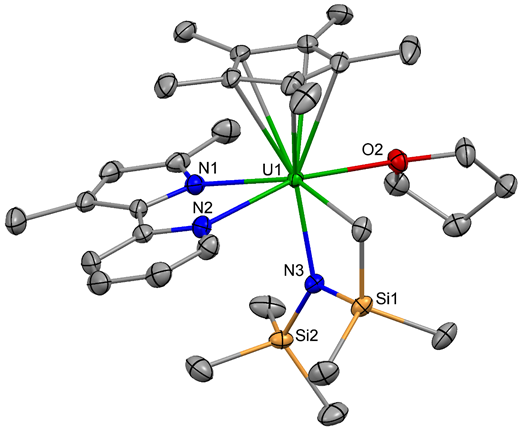
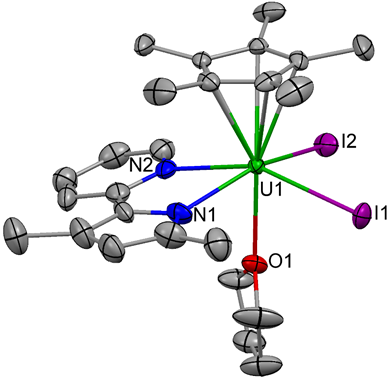
Through collaboration with LANL we started investigating whether uranium catalysis could be modelled using our ligand donation parameter system. Since uranium has accessible π-acceptor orbitals, it was proposed that our system based off of Cr(VI) might be applicable. To summarize, since our electronic values are based off a d0 metal, in which bonding is heavily covalent, modelling the U-based catalysis with Cr-based parameters could show correlation in uranium systems where covalency between uranium and its ligands is important. By developing such a model for a uranium catalysis (similar to our published titanium model) it was proposed that quantitative evaluation of actinide reactivity as a function of ligand properties could be possible. In this way, we could use the degree of correlation to our LDP values as a measure of covalency in uranium-ligand bonding. Some crystal structures of the catalysts we've developed are below.
Through the course of this research, we have discovered some interesting uranium structures. Using bulky amide ligands, it is possible to stabilize rare examples of low valent uranium, some crystal structure examples are below.